Choose the impeller from the installed fan’s duty point, not from warehouse floor area or outside diameter alone. By recording airflow, pressure, speed, temperature and every mechanical dimension, you can separate a safe direct replacement from a redesigned wheel that needs fresh fan and motor checks.
Key takeaways
- Calculate airflow from warehouse volume and required air changes per hour.
- Verify diameter, width, shaft, rotation and clearances before ordering.
- Choose wheel material for dust, moisture, temperature and corrosion exposure.
- Give the supplier a complete replacement brief and test the commissioned wheel.
Start with the warehouse fan duty point
Calculate the duty point before choosing a fan impeller for warehouse ventilation in Delhi. Multiply warehouse volume in cubic metres by the selected air changes per hour: airflow = volume × air changes per hour, reported in m³/h. Convert imported catalogue data using 1 m³/h = 0.5886 CFM.
Add every resistance at the design airflow, including dirty or loaded conditions:
- Intake louvers
- Filters
- Dampers
- Bends and ducts
- Discharge fittings
- Wetted pads, spray sections and eliminators in an air washer
- Scale, fouling and water carryover in the air washer
Record design air temperature, density and Delhi site altitude, about 216 m above sea level. Hot or humid air changes fan performance and motor loading.
| Duty | Selection implication | Critical check |
|---|---|---|
| Comfort ventilation | Volume and air-change target | Make-up air and occupied-zone airflow |
| Process exhaust | Duct and capture resistance | Temperature and corrosion |
| Combustible dust | Specialist radial or spark-resistant design | Ignition and explosion safety |
| Smoke or fumes | High-temperature suitability | Emergency duty and discharge path |
| Boiler or furnace draft | Higher pressure and temperature capability | Materials, seals and motor service |
Plot the fan curve against the system curve and select their operating intersection, not the zero-pressure airflow. System pressure rises approximately with airflow squared.
Fan laws give airflow proportional to speed, pressure to speed squared and power to speed cubed: a 10% speed increase means about 10% more airflow, 21% more pressure and 33% more power.
Provide make-up air. A sealed warehouse, blocked inlet or undersized duct can defeat a correctly selected wheel.
Match every dimension, rotation and clearance
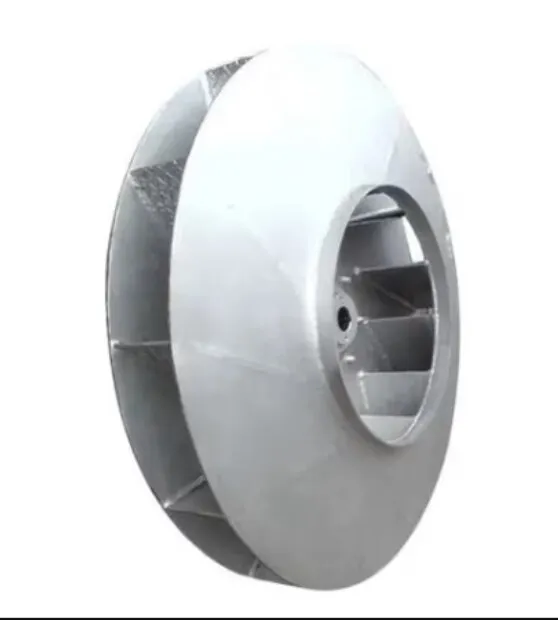
A matching outside diameter proves only that the wheel might enter the casing. Industrial fan impeller sizes also determine inlet area, pressure, airflow, absorbed power and motor load, so two wheels of equal diameter can behave very differently.
1. Record the complete wheel specification: outside diameter, inlet diameter, outlet width, blade height, blade count, blade angle, hub length, bore diameter, shaft diameter, shaft projection, keyway width and depth, mounting pattern, axial clearance and maximum permissible RPM.
2. Check the fan throat, casing cut-off, inlet overlap and housing clearance. A left-hand wheel in a right-hand fan, reversed rotation, incorrect keyway, wrong belt speed or insufficient axial clearance can cause low airflow, noise, rubbing or unstable operation even when the wheel physically enters.
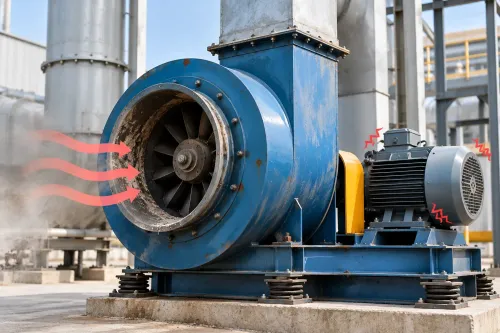
3. For a direct replacement, photograph both sides of the existing assembly before removal. Measure the wheel, hub, bore, keyway, blade angle, blade count and rotation viewed from the drive side; do not trust a photograph or nameplate to provide fit dimensions.
4. Inspect bearing alignment, shaft condition, overhung load, belts, sheaves, coupling and guards. These warehouse ventilation fan parts affect running safety as much as the wheel itself.
5. Label any changed diameter or blade angle as a redesigned impeller, not a direct replacement. Verify motor power, speed, direction and casing dimensions because the change alters airflow, pressure, absorbed power and motor loading. A generic wheel is not a universal fan part.
Choose the wheel type and material for the air
Choose an axial wheel for high air volume through a short, open exhaust path. Choose a centrifugal wheel when ducts, filters, dampers or an air washer create meaningful resistance.
Backward-curved or backward-inclined wheels suit clean air and higher static pressure because their power characteristic is less prone to runaway; forward-curved wheels run at lower speed but react badly to dust deposits and off-design operation.
| Wheel type | Strength | Limitation |
|---|---|---|
| Axial-flow | High volume, low pressure | Poor choice for long or restrictive ductwork |
| Backward-curved/inclined | Efficient, stable power demand | Higher cost and space than simple axial designs |
| Forward-curved | High volume at low speed | Power rises away from design point; dust sensitivity |
| Radial | Handles dirty air and high pressure | More noise and lower efficiency |
Radial wheels suit harsher streams, but smoke, fumes, combustible dust and boiler exhaust require specialist temperature, spark and safety review. Select by duty, not appearance.
MS fan impeller options usually mean welded carbon-steel fabrication. Request the exact steel grade, gauge or plate thickness, weld construction, surface preparation, primer, topcoat, edge and hub protection, and corrosion system. Bare MS fails quickly with monsoon moisture, condensate, corrosive vapours or wet air-washer carryover.
| Material | Corrosion and abrasion | Weight, temperature and repair |
|---|---|---|
| Galvanised steel | Good corrosion resistance; limited after damage | Moderate weight; easy repair |
| Stainless steel | Strong corrosion resistance; grade-dependent abrasion performance | Heavy and costly; weld repair needs control |
| Aluminium | Good corrosion resistance; poor abrasion resistance | Light; lower temperature capability |
| Coated steel | Depends on coating and preparation | Strong and repairable; coating needs inspection |
Keep wheel, casing and shaft materials separate. High-temperature service needs compatible material and dynamic balancing.
Send a complete replacement brief to the supplier
Send the supplier a measured assembly brief, not “fan impeller required.” State whether you need a direct replacement or a performance redesign, and identify dust, corrosive vapour, air-washer moisture, high temperature and cleaning conditions.
- Fan model; casing dimensions; duty point in m³/h or CFM and Pa or mmWG; air temperature; motor power; motor RPM; and rotation viewed from the drive side.
- Impeller outside diameter, inlet diameter, width, blade height, blade count and angle, hub length, bore, shaft diameter and projection, keyway width and depth, axial clearances, mounting pattern and bearing alignment.
- Shaft condition, key details, pulley or coupling sizes, belt data, guards, and existing impeller photographs from both sides. Include every nameplate and date-plate reading.
- Request a dimensioned drawing, fan curve, efficiency, absorbed-power figure, maximum speed, material specification, coating system, dimensional inspection report and delivery scope.
A nameplate cannot supply every fit dimension. Measure the wheel and inspect shaft, bearings, housings and alignment. Require a balancing record stating grade, test speed or method, and whether the hub, shaft, key and complete rotating assembly were included; ISO 21940-11 and AMCA 204 are useful reference frameworks.
Compare a fan impeller supplier in Delhi on evidence, not catalogue diameter.
| Supplier evidence | What to compare | Why it matters |
|---|---|---|
| Drawing and inspection | Traceability, measured dimensions, replacement support | Prevents a mechanically similar mismatch |
| Balance and performance | Dynamic balance, curve, absorbed power, maximum speed | Confirms safe duty operation |
| Delivery support | Lead time, packing, installation and commissioning assistance | Reduces damage and restart risk |
R K Industries Delhi belongs in the comparison only if it supplies this evidence and confirms the measured assembly and duty point, including any MS fan impeller options.
Related product
 | MS Impeller The heart of efficient air movement, our fan impeller delivers unparalleled performance. View product → |
Commission the wheel and decide whether replacement is worthwhile
Before start-up, complete lockout and isolation. Inspect the shaft, bearings, belts, guards, flexible connectors and fasteners; check clearances and rotate the assembly by hand. Verify rotation from the drive side, then measure vibration, record motor current, and compare airflow and static pressure with the design point.
Stop immediately for rubbing, excessive vibration, motor overheating or current above the motor nameplate rating. Document the complete warehouse ventilation fan parts assembly: wheel, hub, shaft, keys, bearings, housings, belts, sheaves or coupling, guards, isolators, access panels and gaskets.
| Replacement or redesign? | Choose replacement when | Choose redesign when |
|---|---|---|
| Direct wheel replacement | Casing, shaft, bearings, motor and duct system pass inspection | Casing is cracked, shaft bent or bearings are worn |
| Performance correction | Dust deposits caused imbalance or reduced airflow | Make-up air is inadequate, filters remain blocked or ducts are undersized |
| Capacity change | Motor carries the revised load within its nameplate rating | The motor cannot carry the revised load |
Clean dusty wheels at an interval set by deposit rate, with access panels and pre-filtration. Uneven deposits create imbalance, increase bearing loads and reduce airflow. Include removal, shaft and bearing checks, balancing, alignment, downtime, commissioning and possible duct repairs in the cost; the metal wheel may be the cheapest part.
Do not assume more RPM means better ventilation. Require sound claims to identify the installed test basis: AMCA 300 data from another room or duct arrangement does not predict warehouse noise. Select a fan impeller for warehouse ventilation in delhi from measured duty, not floor area alone.
Frequently asked questions
How do you calculate the duty point for a warehouse ventilation fan?
Multiply warehouse volume in cubic metres by the selected air changes per hour to calculate airflow in m³/h. Convert catalogue airflow with 1 m³/h = 0.5886 CFM.
What dimensions must you check before replacing a fan impeller?
Check wheel diameter, wheel width, shaft diameter and length, keyway, hub position, rotation, inlet clearance, outlet clearance and the available housing space.
How do you choose an impeller material for warehouse air?
Match the wheel type and material to the air’s dust load, moisture, temperature and corrosive contaminants. Compare MS fan impeller options with materials suited to the operating environment.
What information should you send to a fan impeller supplier in Delhi?
Send the duty point, fan model, wheel dimensions, shaft and keyway details, rotation direction, motor information, operating temperature, air contaminants, photographs and the reason for replacement.
How do you commission a replacement warehouse ventilation impeller?
Inspect fit and clearances, confirm rotation, balance and secure all fasteners before operation. Measure airflow, pressure, vibration, noise and motor current against the required duty.
Keywords