The right FD fan depends on the air volume, pressure, temperature, dust load and control range your furnace or boiler actually demands—not on motor horsepower or a catalogue airflow alone. By matching the draft arrangement, fan construction, site conditions and operating point, you can narrow the capacity and specification before requesting comparable quotations.
Key takeaways
- Start with the draft arrangement and required furnace pressure.
- Match centrifugal or axial fans to resistance, airflow and space.
- Calculate capacity from burner duty, system resistance and Delhi conditions.
- Request performance curves, test conditions and fouling allowances in writing.
Start with the draft arrangement, not the fan catalogue
Choose a forced-draft arrangement when combustion air must be pushed into the burner, windbox and furnace at positive pressure. An FD fan does not replace an induced-draft fan: the ID fan pulls flue gas through the heat-transfer surfaces and stack on the suction side.
For a boiler, furnace or process heater, match the arrangement to furnace-pressure control:
| Arrangement | Fan action | Where it fits | What goes wrong if misapplied |
|---|---|---|---|
| Forced draft | Pushes combustion air in | Sealed or modestly pressurised systems with adequate flue-gas exit | Excess pressure can drive hot gas through doors, seals and inspection openings |
| Induced draft | Pulls flue gas out | Systems designed to operate under negative furnace pressure | Insufficient combustion-air pressure causes poor mixing, smoke and burner instability |
| Balanced draft | FD supplies air while ID removes flue gas | Boilers and heaters needing controlled furnace pressure across changing loads | Mismatched fans cause positive pressure, air leakage or excessive stack suction |
Select FD capacity from the burner’s air-flow and pressure envelope, including excess air and purge duty. Stoichiometric air alone is not enough: fuel, burner design, leakage and emissions controls change the requirement.
For industrial combustion fan options, start with the draft arrangement and system resistance, not a catalogue motor rating. A balanced-draft plant requires FD and ID fans sized together, with furnace pressure checked at minimum load, maximum firing and purge.
Centrifugal fans suit rising pressure demand; axial fans fit very large air volumes with low resistance and a compact straight-through layout.
Compare centrifugal and axial FD fan types against plant conditions
Choose the fan by system resistance first: high static pressure, wide turndown or dirty air points toward centrifugal equipment; very high airflow at low resistance and a straight-through layout point toward axial equipment.
| Option | Pressure and airflow | Dust, control and layout |
|---|---|---|
| Centrifugal backward-inclined or airfoil | Handles higher pressure and broad operating ranges efficiently; suitable for combustion-air systems with duct, burner and damper resistance | Best for clean to moderately dusty air and stable variable-speed control; needs more space than an axial fan |
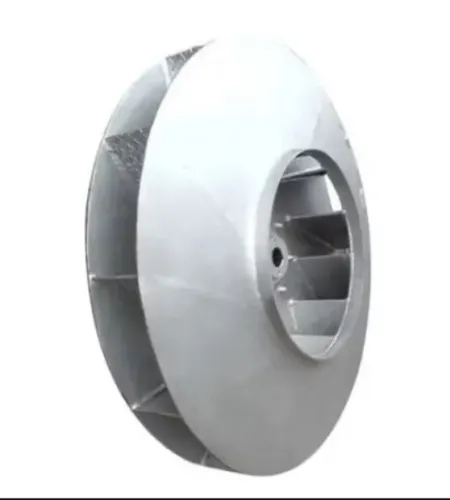
| Centrifugal radial-blade | Produces useful pressure and tolerates dust, erosion and heavier particulate better | Choose it for dirty intake air or abrasive service; accept lower efficiency and higher noise |
| Axial-flow | Moves very large air volumes at comparatively low pressure with a compact, straight-through arrangement | Fits clean-air, low-resistance systems; becomes less attractive when pressure rises or wide turndown demands stable operation |
The main forced draft fan types must also match the burner’s purge and excess-air points, not only normal firing. A fan that meets stoichiometric air but cannot reach purge flow, or that stalls at minimum load, creates an operating problem.
For multiple boilers or process lines, parallel smaller fans can preserve production during maintenance and improve low-load control. One larger fan reduces footprint and installed equipment, but a single failure removes the shared air supply; compare that risk with extra valves, controls and maintenance points.
State actual or reference-condition airflow, minimum and maximum inlet temperatures, dust loading and required pressure in the specification. Delhi air density changes with elevation and hot or preheated intake air, so catalogue motor power alone cannot prove the selection.
Size FD fan capacity from the burner duty and system resistance
Set the FD fan duty from the burner’s required air volume and the system’s total static-pressure rise. Use excess-air and purge requirements, not stoichiometric air alone: fuel, burner design, furnace leakage and emissions controls change the normal firing flow, while purge can create a separate peak duty.
Build the pressure total from the burner register, windbox, air heater, ducts, bends, dampers, filters and the specified fouling margin. The operating point is where this system-resistance curve intersects the fan curve. An oversized fan throttled by a damper wastes power, increases noise and can make combustion control unstable.
Ask each supplier to state these figures at the same conditions:
- Actual volumetric flow in m³/h, or clearly identified standard/reference flow
- Total or static pressure at the fan inlet temperature
- Normal firing point, purge point and available turndown
- Fan speed, efficiency, sound level and motor input
- Minimum and maximum inlet-air temperatures, with density and power checks
| Check | Option A | Option B |
|---|---|---|
| Normal firing | Flow and pressure at duty point | Flow and pressure at duty point |
| Purge | Separate curve or documented margin | Separate curve or documented margin |
| Fouling | Pressure allowance identified | Pressure allowance identified |
| Motor | Sized from absorbed power | Sized from absorbed power |
Compare FD fan capacity options at identical flow, pressure and inlet temperature. Motor kW only tells you the drive’s rating; it does not prove that the impeller delivers air into the burner register. Include Delhi’s lower air density and hot or preheated intake air in the final pressure, mass-flow and motor calculations.
Correct the duty for Delhi air, temperature and intake fouling
Use Delhi’s actual inlet conditions, not a catalogue default. State airflow as actual volume or standard/reference flow, then recalculate air density at the site’s minimum and maximum inlet temperatures. Delhi’s elevation and hot or preheated air alter mass flow, fan pressure and shaft power.
A fan that meets volume at 20°C can overload its motor at a hotter inlet.
Particulate loading makes the intake a duty issue, not merely a housekeeping issue. Include the filter’s dirty differential pressure in total resistance and provide:
- A pre-separator or filter suited to the expected dust load
- Differential-pressure gauges or transmitters across each filter stage
- Access doors and drain arrangements for cleaning
- Inspection access to the impeller, casing and burner register
- An erosion and corrosion review for exposed components
Do not choose the most efficient wheel automatically. A backward-curved airfoil wheel can lose efficiency after dust fouling or suffer erosion; a radial or backward-inclined wheel with replaceable wear protection can deliver better life-cycle performance.
Specify the motor for the worst-case density and dirty-filter pressure, with a service factor confirmed by calculation. Use a VFD when combustion-air demand changes, but establish minimum speed, purge flow, flame stability, motor cooling and resonance limits with the burner control scheme.
Require shop balancing and vibration limits to AMCA 204, plus aerodynamic performance data tested to AMCA 210.
Build a quotation brief that exposes the real performance difference
Give an FD fan supplier in Delhi a signed duty sheet, not a request for “a 50 hp fan.” State normal and maximum air volume, burner and purge requirements, total pressure rise, inlet temperature, air density, fuel, excess-air target, operating hours and expected filter fouling.
Require the quotation to show the complete operating point. Compare fd fan capacity options only when each quotation uses the same flow, pressure, temperature, speed, efficiency and sound-level basis.
- Fan performance curve, system-resistance curve and quoted duty point
- AMCA 210 test basis or equivalent laboratory performance evidence
- Impeller balance grade, shop-balancing record and vibration limit under AMCA 204
- Motor rating, starting current, VFD compatibility, speed range and efficiency
- Bearing type, lubrication interval, inlet-temperature limit, materials and coating
- Filter or pre-separator pressure drop, differential-pressure gauge, drains and cleaning access
- Commissioning readings for flow, pressure, speed, vibration, temperature and motor current
- Recommended spares, delivery lead time and Delhi site-service response
| Quotation item | Weak comparison | Evidence that exposes the difference |
|---|---|---|
| Airflow | Nominal m³/h only | Actual volume at design temperature and density |
| Pressure | Fan pressure without system losses | Pressure including burner register, air heater, ducts, bends, dampers, filters and fouling margin |
| Motor | Larger kW treated as better | Duty-point efficiency, operating margin and VFD range |
| Construction | “Heavy duty” wording | Impeller material, erosion review, coating and balancing certificate |
R K Industries Delhi can be assessed fairly only against this same evidence set; a catalogue rating cannot show whether the fan will meet combustion duty without noisy throttling or unstable operation.
Related products
 | ID and Fan Blower ₹10000 Enhance combustion efficiency with our advanced FD fan. Designed for precise air regulation, it optimizes fuel combustion in boilers and furnaces,... View product → |
 | Industrial Blower Empower your industrial processes with our Force Draft Fan, engineered for unparalleled airflow regulation. View product → |
Frequently asked questions
What should you decide before comparing FD fan types?
Define the draft arrangement, combustion-air route, burner duty, required furnace pressure and system resistance before choosing a fan.
When is a centrifugal FD fan preferable to an axial fan?
Choose a centrifugal fan when the system has higher resistance from ducts, dampers, air preheaters, filters or burner equipment.
How do you size FD fan capacity for an industrial plant?
Start with the burner’s combustion-air requirement, then calculate the airflow and pressure needed to overcome the complete system resistance.
How do Delhi conditions affect FD fan selection?
Correct the duty for Delhi air density, operating temperature and intake fouling so the fan delivers the required mass flow at site conditions.
Related product
 | ID and Fan Blower ₹22000 Maximize boiler efficiency with our high-performance boiler fan. View product → |
Keywords